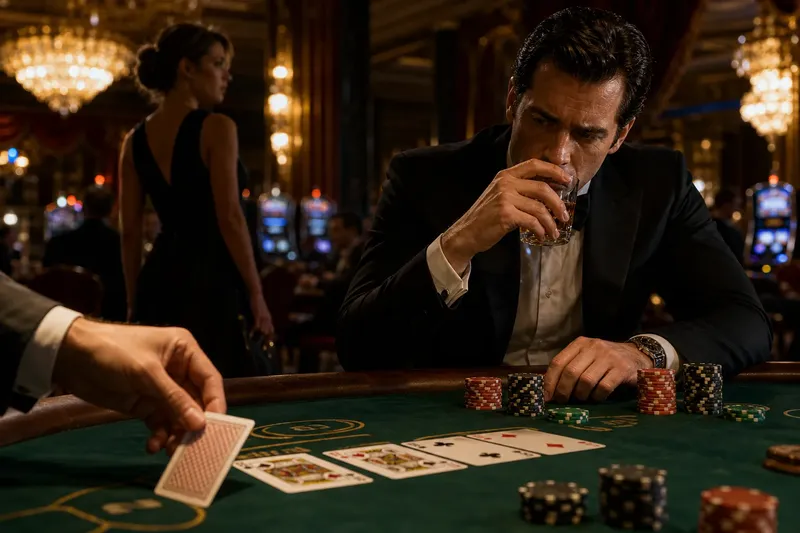
How Novels and Films Give Casino Scenes Different Dramatic Jobs
Compare how novels and films shape casino scenes, and learn to adapt a character’s private calculation into screen action without losing its purpose.

A roulette wheel clicks as a character folds a note and slips it into a pocket. In a novel, that gesture might sit beside a memory the character cannot voice. On screen, the note can become a clue another person spots. Adapting a casino scene means deciding which version best serves its dramatic purpose—not preserving every detail from one medium in the other.
Novels and films organize information differently
Prose can move directly through memory, explanation, and a character’s private contradictions. Film presents information through images, sound, performance, and editing. Neither form owns a particular kind of scene; each offers different ways to control what an audience knows and when.
This distinction matters in casino fiction because the setting can offer many competing signals: a game’s rules, a conversation, a character’s hidden motive, or a familiar sound. A novel can pause to explain why one detail matters. A film can let a detail recur, change, or be misunderstood before anyone explains it.
Prose can shape a reader’s access to thought
A novelist can place an excuse beside the thought it conceals. A character might insist internally that they are waiting for a friend, then remember that the friend never agreed to meet. That gap between self-description and memory gives the reader information the character may be avoiding.
Prose can also shift between the present and a remembered event without staging a new location. The transition works best when it changes how the reader understands the current action. If a memory only repeats what the scene already communicates, it may be more effective to cut it or let a present-day detail trigger it briefly.
Film can control information through framing and sound
A camera can show a character reading a note while keeping its words outside the frame. A cut to another person watching may reveal that the act of reading has been noticed. Sound can do similar work: a name called from elsewhere may interrupt a conversation, while the camera stays with the listener rather than showing who spoke.
These choices are not substitutes for thoughts word for word. They create a different sequence of information. The viewer may first see a reaction, then learn what caused it; a reader, by contrast, may know the character’s interpretation before another person sees the same event.
Adapt the information pattern, not just the plot event
Before changing a scene, identify what the audience learns, what the character believes, and what remains uncertain. Then decide whether the adaptation should preserve that order. The essential turn may be a discovery, a misreading, or a decision made with incomplete information.
- Audience knowledge: Check what the reader or viewer knows before the scene ends. If the audience should know more than the character, preserve that advantage; if not, withhold the relevant clue until the character encounters it.
- Character belief: Check what the character thinks is happening. If that belief drives the scene, keep it legible through narration, dialogue, or reaction; if it does not affect a choice, consider removing the explanation.
- Uncertainty: Check what remains unexplained. If uncertainty creates suspense, keep the source of doubt in place; if it only causes confusion, add a clear clue or revise the sequence.
- Repeated detail: Check whether a sound, object, or game element changes meaning when it returns. If it develops the audience’s understanding, retain the recurrence; if it repeats without adding information, remove or alter it.
- Point of view: Check whose knowledge shapes the scene. If the adaptation changes viewpoint, provide a visible or audible reason for the audience to understand the new perspective; if no such reason exists, stay closer to the original viewpoint.
- Scene result: Check what the audience knows or suspects afterward. If that knowledge changes the next interaction, carry it forward; if it does not, reconsider the scene’s place or ending.
Imagine a novel scene begins with a character carrying an unsigned note and believing a companion has betrayed them. The writer wants the film audience to share that suspicion before learning the truth. First, keep the note’s signature hidden by framing it from the character’s side. Next, show the character watching the companion speak with a dealer, but omit the conversation’s words. Then let the companion leave a second note on the table, with a matching fold but a different message: the first note was meant as a warning, not evidence of betrayal. The audience’s initial suspicion gives way to a clearer explanation, while the film replaces the novel’s direct account of the character’s reasoning with a controlled reveal.
How should a casino scene manage what the audience knows?
How can a novel create dramatic irony?
Give readers information a character lacks, such as a message the character has misread. Let that knowledge affect how readers interpret later choices, rather than explaining the irony repeatedly.
How can a film withhold a clue fairly?
Show the clue’s context while keeping its decisive detail out of view or inaudible. When the detail is revealed, viewers should be able to recognize what they saw or heard earlier.
Should an adaptation preserve the original viewpoint?
Preserve it when the audience’s access to one character’s knowledge creates the scene’s main effect. Change it when another viewpoint reveals a more useful conflict, and make the shift clear through framing, sound, or scene order.
When does a casino detail distract from the scene?
A detail distracts when it draws attention but changes neither the audience’s understanding nor a character’s choices. Keep it when its return, meaning, or timing alters what the scene communicates.
Use the casino setting to shape the reveal
A casino interior can provide useful layers of sound, sightlines, and overlapping activity, but it need not be explained like a floor plan. A dealer’s announcement, a reflection in a glass partition, or a note placed beside a stack of chips can help control what the audience notices. Choose a detail because it affects information flow, not just because it identifies the location.
Think of adaptation like rearranging a deck of cards: the same pieces can produce a different sequence, and the order changes what a player can see. For a novel-to-film casino scene, the central question is not whether every thought survives, but whether the audience receives the right clues at the right moments.
When revising, read or watch the scene’s transition into what follows. If the reveal changes a character’s trust, suspicion, or plan, the next exchange should reflect that new knowledge. That trace keeps the scene’s information pattern alive after the casino doors close.